The Internet Transparency Stack: from principles to practice
The rules exist. You cannot see them.
The rules on transparency are not new. The OECD Privacy Guidelines set out openness as a principle in 1980. Convention 108, opened for signature in 1981, has 55 Parties. The UN General Assembly affirmed the right to privacy in the digital age in Resolution 68/167 in 2013.
The gap is not the rules. It is that the rules are invisible at the moment they matter: before a person is asked to identify themselves, and before their data crosses a border. At that moment a person usually cannot see who is accountable, what will be done with what is collected, or on whose authority. Afterwards they hold nothing that shows what they were told.
That gap now matters most for AI. Systems that collect, infer and act at scale take in personal data and knowledge with no record the person keeps. The difference between clean AI and dirty AI is whether that record exists. We call the condition we are after Trustparency: transparency strong enough to support an enforcement decision, not a compliance checkbox.
Invisible power has been made legible before
In 1217 the Charter of the Forest limited the royal forest and restored common rights within it. Its boundaries were walked and recorded, so that people could know where forest law applied and where it did not. The rules mattered because people could see where they stood.
The bank receipt did the same for money. A depositor could not inspect a bank’s books, but could hold a dated record of what they had handed over and on what terms. That record made the bank answerable to the depositor, not only to its supervisor.
Personal data needs the same thing: evidence that travels with the interaction and stays with the person.
Four things that must be inspectable
The stack answers one question: what is the minimum that must be inspectable before an identifier is linked with an individual, and before data crosses a border? Four things.
- Who is accountable. A controller identity record: the party responsible, resolvable before the person is identified.
- What for, and on what authority. A machine-readable notice: purpose, legal basis and scope, declared in advance and versioned.
- That the notice was issued, and when it changed. A notice event log, append-only, that shows each version and each material change. (Digital Transparency Ledger)
- Proof of what was disclosed. A notice receipt: evidence that this notice, at this version, was presented at this time, held by the person.
The stack, layer by layer
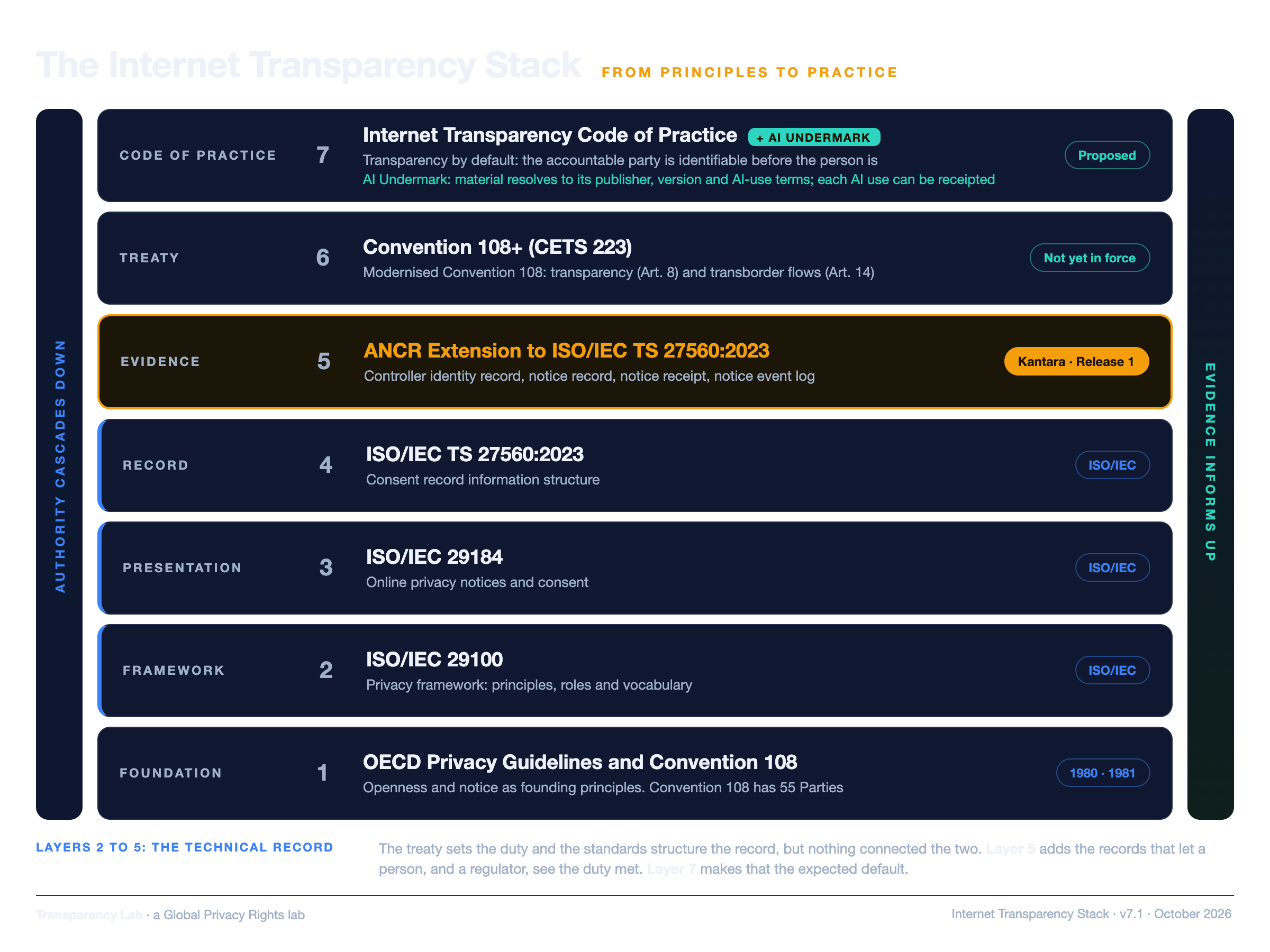
Authority runs down the stack: each layer takes its force from the one above. Evidence runs up: each layer is made checkable by the one below.
1. Foundation: the OECD Privacy Guidelines (1980) and Convention 108 (1981). Openness and notice as founding principles of data protection, across every later instrument.
2. Framework: ISO/IEC 29100. The privacy framework: principles, roles such as controller and PII principal, and a shared vocabulary.
3. Presentation: ISO/IEC 29184. How online privacy notices are presented and how consent is obtained.
4. Record: ISO/IEC TS 27560:2023. The consent record information structure: a standard format for recording consent.
5. Evidence: the ANCR Extension to ISO/IEC TS 27560:2023. Published by the Kantara Initiative’s ANCR Work Group as Release 1. It adds the four records above: the controller identity record, the notice record, the notice receipt and the notice event log. This is the layer that was missing. Layers 2 to 4 describe notices and record the authority as consent; layer 5 produces evidence that a notice was given, which a person and a regulator can both check.
6. Treaty: Convention 108+ (CETS 223). The modernised Convention 108, with transparency duties in Article 8 and transborder flows in Article 14. It is not yet in force: as of September 2026 it has 34 of the 38 ratifications it needs.
7. Code of practice: the Internet Transparency Code of Practice. Proposed. Transparency by default: the accountable party is identifiable before the person is, and leaves records a regulator can inspect. A code does not create new obligations. It sets out how existing ones are met in practice, so that the same evidence works across jurisdictions without bespoke arrangements. It includes a proposed AI Undermark, described below.
Why layer 5 is the hinge
The treaty sets the duty and the standards structure the record, but until now nothing connected the two. A consent record shows that consent was recorded. It does not show what the person was told, by whom, under which version of the notice, or what has changed since. The duty in Article 8 is a duty to inform. Meeting it leaves evidence only if the notice itself is recorded.
The records in layer 5 do that. They are published by the accountable party, resolvable by anyone, and the receipt is held by the person rather than only by the operator. A regulator can check them from public records without access to anyone’s personal data. A person can show later what they were told.
Applying the stack to AI: the undermark
The same four records can govern what an AI system does with published material. An undermark is a mark carried with a report, a dataset or a web page that resolves to records anyone can check: who published it, which version it is, the terms on which it may be used, including by AI, and the history of those terms. Where an AI system retrieves, cites or trains on undermarked material under those terms, a receipt can record that use: which version, under which terms, by whom, and for what purpose.
Marks embedded in content can be stripped. The undermark does not depend on the mark surviving, because the records it resolves to are published by the accountable party and stay where they are. Where reuse terms are not met, a publisher can declare a reservation, such as the text and data mining reservation under Article 4(3) of Directive (EU) 2019/790. That is a declared reservation and a signal, not enforcement. The undermark makes AI use transparent and evidenced where agents honour the terms. It does not stop those that do not.
The Internet Transparency Code of Practice requires the AI Undermark for material published under it. itcop.org carries it now: a reservation that points to its machine reuse terms, and a Level 0 undermark on the Clean AI Receipts paper, with the resolver still to come.
What is in place, and what is not
Layers 1 to 4 are published. Layer 5 is published as Release 1 and can be implemented now. Layer 6 is signed but not yet in force. Layer 7 is a proposed code; the AI Undermark it requires is already carried by itcop.org at Level 0. That ordering is the point: the evidence does not have to wait for the treaty or the code. An organisation can publish its controller record, notice, event log and receipts today, and be ready when the top of the stack arrives.
How Transparency Lab uses the stack
We assess what services actually disclose against these published standards, and publish the evidence. Our controller self-assessment checks a service against the ANCR transparency indicators and the eight conformance criteria of the ANCR Extension, with modules for AI transparency and age assurance. For regulators, procurement teams and investors, we assess third parties with the evidence attached.
The aim is plain: no identification without accountability, and no transfer across a border without conditions a person can inspect.
Transparency Lab, a Global Privacy Rights lab. Published by Global Privacy Rights. Contact info@transparencylab.ca.